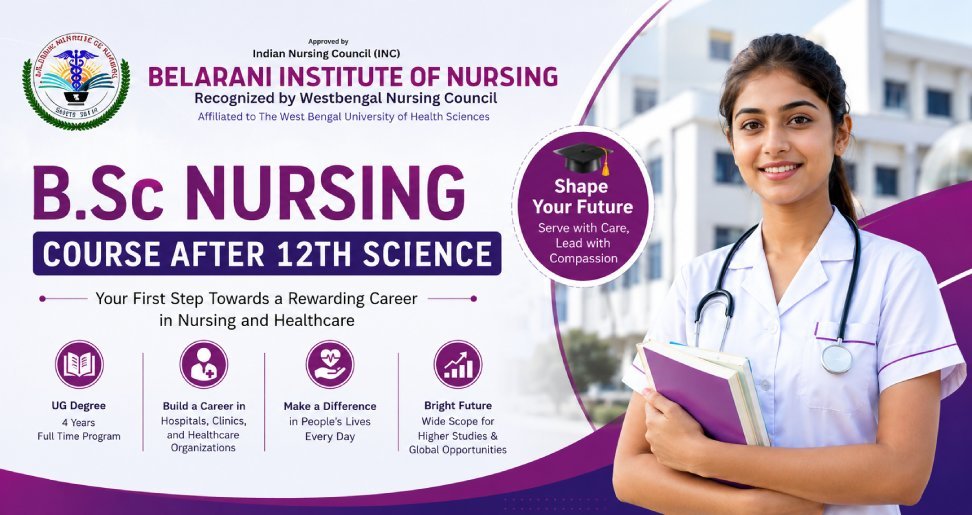
Choosing the right career after completing Class 12 Science can shape your professional future. For students interested in healthcare, patient care, and medical science, a B.Sc Nursing course after 12th Science is an excellent option. The programme combines scientific knowledge, clinical training, practical skills, and patient-care education to prepare students for a rewarding career in the healthcare sector.
Students who have completed 12th with Science, particularly with Physics, Chemistry, and Biology (PCB), can explore B.Sc Nursing as a professional undergraduate degree. Institutions such as Belarani Nursing Institute provide aspiring nursing students with an opportunity to develop the academic and practical skills required for a career in nursing.
What Is a B.Sc Nursing Course?
B.Sc Nursing is a four-year undergraduate professional degree that focuses on nursing science, healthcare, patient management, clinical practice, and community health. The course prepares students to work as qualified nursing professionals in hospitals, clinics, healthcare centres, community health programmes, and other medical settings.
The programme includes classroom learning as well as practical and clinical training. Students learn about human anatomy, physiology, pharmacology, microbiology, nutrition, medical-surgical nursing, child health nursing, mental health nursing, and community health nursing.
Can You Do B.Sc Nursing After 12th Science?
Yes, students can pursue B.Sc Nursing after completing Class 12 Science, subject to the eligibility requirements applicable to the institution and relevant nursing authorities.
Generally, students should have completed 10+2 with Physics, Chemistry, and Biology (PCB) along with English from a recognised board. The minimum marks and other admission requirements may vary depending on the college, university, state, and applicable regulations.
Students should always check the latest eligibility criteria before applying because admission requirements can change.
Eligibility for B.Sc Nursing After 12th
The commonly followed eligibility requirements include:
- Completion of Class 12 or equivalent examination from a recognised board.
- Physics, Chemistry, and Biology as core subjects.
- English as a subject in the qualifying examination.
- Meeting the minimum qualifying marks prescribed by the concerned institution or authority.
- Meeting the applicable age and medical fitness requirements, wherever specified.
- Admission through the applicable entrance examination or merit-based process, depending on the institution and rules.
Students should verify the current admission guidelines of their preferred nursing college before submitting an application.
B.Sc Nursing Course Duration
The B.Sc Nursing programme generally has a duration of four years. During this period, students receive theoretical education, laboratory exposure, practical nursing training, and clinical experience.
Clinical training is an important part of nursing education because it allows students to understand how theoretical concepts are applied while caring for patients under appropriate supervision.
Major Subjects in B.Sc Nursing
The B.Sc Nursing curriculum covers a wide range of healthcare and nursing-related subjects. Depending on the university and curriculum, students may study areas such as:
- Anatomy
- Physiology
- Biochemistry
- Nutrition and Dietetics
- Psychology
- Microbiology
- Pharmacology
- Pathology
- Medical-Surgical Nursing
- Child Health Nursing
- Mental Health Nursing
- Community Health Nursing
- Obstetric and Gynaecological Nursing
- Nursing Research
- Nursing Management and Administration
These subjects help students develop a strong foundation in medical science and professional nursing practice.
Practical and Clinical Training
One of the most important aspects of a B.Sc Nursing course is practical education. Nursing students need more than theoretical knowledge because their future responsibilities involve direct patient care.
During clinical training, students can learn about patient assessment, monitoring vital signs, maintaining hygiene, administering medicines under supervision, assisting healthcare professionals, maintaining patient records, providing emotional support, and following healthcare safety practices.
Practical exposure also helps students improve communication, teamwork, decision-making, and patient-management skills.
Why Choose B.Sc Nursing After 12th Science?
B.Sc Nursing can be a suitable choice for students who want to build a professional career in healthcare. Some important advantages include:
1. Professional Healthcare Career
Nursing is an essential part of healthcare delivery. Qualified nurses work alongside doctors and other healthcare professionals to provide continuous patient care.
2. Strong Practical Exposure
The course combines academic learning with practical and clinical training, helping students understand real healthcare environments.
3. Multiple Career Opportunities
After completing B.Sc Nursing, graduates can explore opportunities in hospitals, nursing homes, clinics, community healthcare, educational institutions, and other healthcare organisations.
4. Scope for Higher Education
Graduates can pursue advanced education and specialisation in nursing or related healthcare fields according to their career goals and eligibility.
5. Development of Professional Skills
The programme helps students develop communication, clinical, leadership, teamwork, and patient-care skills that are valuable throughout their professional careers.
Why Choose Belarani Nursing Institute?
For students searching for a suitable institution to pursue nursing education, Belarani Nursing Institute can be considered as an option for building a foundation in professional nursing.
The institute focuses on nursing education and practical learning to help students understand both the academic and clinical aspects of the profession. Students can gain exposure to nursing subjects, patient-care practices, clinical procedures, and professional responsibilities.
Before taking admission, students and parents should review the institute’s current eligibility criteria, course structure, facilities, clinical training arrangements, admission process, and applicable approvals or affiliations.
Career Opportunities After B.Sc Nursing
After completing a B.Sc Nursing degree and fulfilling the applicable professional registration requirements, graduates can explore different career paths, including:
- Staff Nurse
- Clinical Nurse
- Community Health Nurse
- Nursing Supervisor
- Public Health Nurse
- Nursing Educator
- Hospital Administrator
- Research Assistant
- Healthcare Coordinator
Career opportunities can vary depending on qualifications, registration, experience, specialisation, location, and employer requirements.
Higher Study Options After B.Sc Nursing
Students who want to continue their education after graduation can consider postgraduate and specialised programmes. Depending on eligibility and current regulations, options may include M.Sc Nursing, postgraduate healthcare programmes, nursing specialisations, research-oriented courses, and management-related programmes.
Higher education can help nurses develop specialised knowledge and potentially move towards teaching, research, leadership, administration, or advanced clinical roles.
How to Choose the Right B.Sc Nursing College?
Choosing a nursing college requires careful research. Students should consider:
- Recognition and applicable approvals
- University affiliation
- Faculty and teaching quality
- Clinical training opportunities
- Laboratories and nursing skill facilities
- Hospital exposure
- Course curriculum
- Admission requirements
- Student support services
- Location and accessibility
- Placement or career guidance facilities
It is also advisable to visit the institution, speak with the admission team, and verify official information before making a final decision.
Conclusion
A B.Sc Nursing course after 12th Science can be a strong career option for students who are passionate about healthcare, science, patient care, and serving society. The four-year programme provides a combination of academic knowledge, practical education, and clinical exposure that can prepare students for different nursing career pathways.
Students looking for nursing education can explore institutions such as Belarani Nursing Institute and compare their course structure, eligibility, facilities, clinical training, and admission requirements before making a decision. With the right education, practical experience, professional registration, and continuous learning, B.Sc Nursing graduates can build a meaningful career in the healthcare sector.
Frequently Asked Questions ( FAQs ) :-
Ans :- Yes. Students who complete 12th Science with the required subjects, generally including PCB and English, can apply for B.Sc Nursing subject to applicable eligibility criteria.
Ans :- B.Sc Nursing is generally a four-year undergraduate degree programme.
Ans :- Physics, Chemistry, and Biology are generally required subjects, along with English, subject to the applicable admission rules.
Ans :- Yes, it can be a suitable career option for students interested in healthcare, patient care, clinical practice, and nursing services.
Ans :- Graduates can explore nursing and healthcare roles and may also pursue higher education or specialised programmes, depending on eligibility and applicable regulations.
Ans :- Students can explore Belarani Nursing Institute and compare its current admission requirements, academic programme, clinical training, facilities, and applicable approvals before applying.