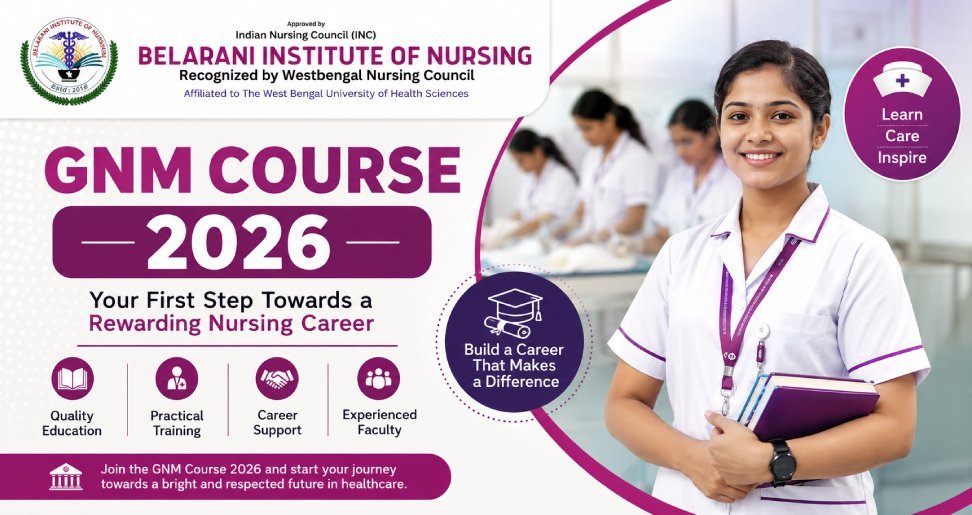
General Nursing and Midwifery (GNM) is one of the most sought-after nursing courses for students who want to build a career in healthcare. The GNM Course 2026 offers students an opportunity to develop professional nursing knowledge, clinical skills, patient-care abilities, and practical experience. With the growing demand for trained healthcare professionals, GNM remains a valuable career-oriented course for students interested in nursing and healthcare services.
Choosing the right nursing institute is an important step toward developing a successful nursing career. Institutions such as Belarani Nursing Institute can provide aspiring nursing students with an environment focused on academic learning, practical training, clinical exposure, and professional development.
What Is the GNM Course?
GNM stands for General Nursing and Midwifery. It is a professional nursing programme designed to train students in patient care, nursing procedures, healthcare management, maternal care, child care, community health, and other essential areas of nursing.
The course combines classroom education with practical and clinical training. Students learn how to assist healthcare professionals, monitor patients, maintain medical records, provide basic nursing care, and respond appropriately to different healthcare situations.
The GNM programme is particularly suitable for students who want to enter the nursing profession and gain practical healthcare experience.
GNM Course 2026: Eligibility Criteria
Students planning to apply for GNM admission in 2026 should carefully check the eligibility requirements prescribed by the relevant nursing authorities and institution.
Generally, applicants are expected to:
- Complete their 10+2 or equivalent examination from a recognised board.
- Meet the required minimum academic marks specified by the applicable admission authority.
- Fulfil the prescribed age requirements.
- Meet any subject-specific requirements applicable to the admission process.
- Satisfy medical and other conditions, wherever required.
Because eligibility rules can vary according to the state, nursing council, university, and admission authority, candidates should verify the latest requirements before applying for the GNM Course 2026.
GNM Course Duration
The GNM programme generally involves multiple years of academic and practical nursing education, including classroom instruction, laboratory learning, and clinical training. The exact course duration, internship requirements, and training structure may vary according to the applicable regulatory guidelines.
Clinical training is an important part of the programme because it helps students understand how theoretical nursing knowledge is applied in real healthcare environments.
GNM Course 2026 Admission Process
The admission procedure for GNM courses can differ between states and institutions. Students should therefore understand the specific process followed by their preferred nursing institute.
A typical admission process may include:
- Checking eligibility requirements.
- Completing the application form.
- Submitting academic and personal documents.
- Participating in the applicable selection or admission process.
- Completing document verification.
- Paying the required admission and course fees.
- Beginning academic and clinical training after admission.
Students interested in GNM Admission 2026 should start preparing their documents and monitor official admission announcements to avoid missing important deadlines.
Subjects Covered in GNM
GNM education covers different areas of nursing and healthcare. Depending on the curriculum applicable to the institution, students may study subjects and areas such as:
- Fundamentals of Nursing
- Anatomy and Physiology
- Microbiology
- Psychology
- Sociology
- Community Health Nursing
- Medical-Surgical Nursing
- Child Health Nursing
- Mental Health Nursing
- Midwifery and Gynaecological Nursing
- Nutrition
- First Aid and Emergency Care
- Nursing Administration and Management
These subjects help students develop a combination of theoretical understanding and practical nursing skills.
Importance of Practical and Clinical Training
Nursing is a profession where practical skills are as important as academic knowledge. For this reason, clinical exposure plays a major role in GNM education.
During practical training, students can learn about patient communication, vital-sign monitoring, nursing procedures, hygiene and infection-control practices, medication-related responsibilities, documentation, and patient support under appropriate supervision.
A well-structured learning environment can help students become more confident and responsible while dealing with patients and healthcare teams.
Career Opportunities After GNM
Completing a GNM programme can open the door to several opportunities in the healthcare sector. Depending on qualifications, registration, experience, and applicable recruitment requirements, GNM graduates may explore roles such as:
- Staff Nurse
- General Nurse
- Community Health Nurse
- Nursing Assistant
- Home Healthcare Nurse
- Hospital Nurse
- Clinical Support Staff
- Nursing Care Coordinator
GNM-qualified professionals may find opportunities in hospitals, nursing homes, clinics, community healthcare programmes, home healthcare services, and other healthcare organisations.
Students can also consider pursuing higher education and additional professional qualifications after completing GNM, subject to applicable eligibility requirements.
Why Choose Belarani Nursing Institute?
Selecting a nursing institute is an important decision because the quality of education and practical exposure can influence a student’s professional development.
Belarani Nursing Institute is a suitable option for students looking for a focused environment for nursing education. Prospective students should consider factors such as faculty support, practical training opportunities, clinical exposure, learning facilities, academic guidance, student support, and the institute’s overall educational environment before making their final decision.
Students can contact Belarani Nursing Institute directly to learn about the latest GNM admission process, eligibility requirements, available facilities, course structure, and other admission-related information for 2026.
Skills Students Develop During GNM
Apart from academic knowledge, GNM education helps students develop important professional skills. These include:
- Patient communication
- Basic clinical and nursing procedures
- Teamwork and coordination
- Time management
- Observation and decision-making
- Patient documentation
- Hygiene and infection-control awareness
- Emergency response skills
- Compassionate patient care
These skills are essential for working effectively in a healthcare environment.
Things to Consider Before GNM Admission 2026
Before selecting a GNM programme, students should compare different institutions carefully. Check whether the institute meets the applicable regulatory requirements and whether the course structure, practical training, clinical exposure, facilities, faculty, and admission conditions are suitable for your career goals.
Students should also understand all applicable fees, documentation requirements, attendance rules, training arrangements, and registration requirements before completing admission.
Conclusion
The GNM Course 2026 can be an excellent choice for students who want to establish a professional career in nursing and healthcare. The programme combines theoretical education with practical and clinical learning, helping students develop the knowledge and skills required for patient care.
However, choosing the right institute is just as important as choosing the course. Students looking for a nursing education opportunity can explore Belarani Nursing Institute and learn more about its GNM programme, admission process, training facilities, and academic environment.
If you are planning to pursue nursing after 10+2, start researching your options early, verify the latest eligibility and admission guidelines, and select an institute that supports both your academic learning and professional development.