We’re going to be honest with about nursing career as we knowmost nursing promotions lead with the good stuff, meaningful work, making a difference, noble profession, job security. But here we will cover the real side of the story too
What they leave out is the part our students discover about six months into a hospital placement. Twelve-hour shifts that don’t feel like twelve hours because there’s no time to sit down. Two staff short on a ward that needs four. The emotional weight of a difficult patient death that you carry home and can’t quite put down. The gap between what the career sounded like and what it asks of you daily.
We tell students both versions upfront. Because the ones who go in knowing the full picture do better than the ones who find out mid-placement.
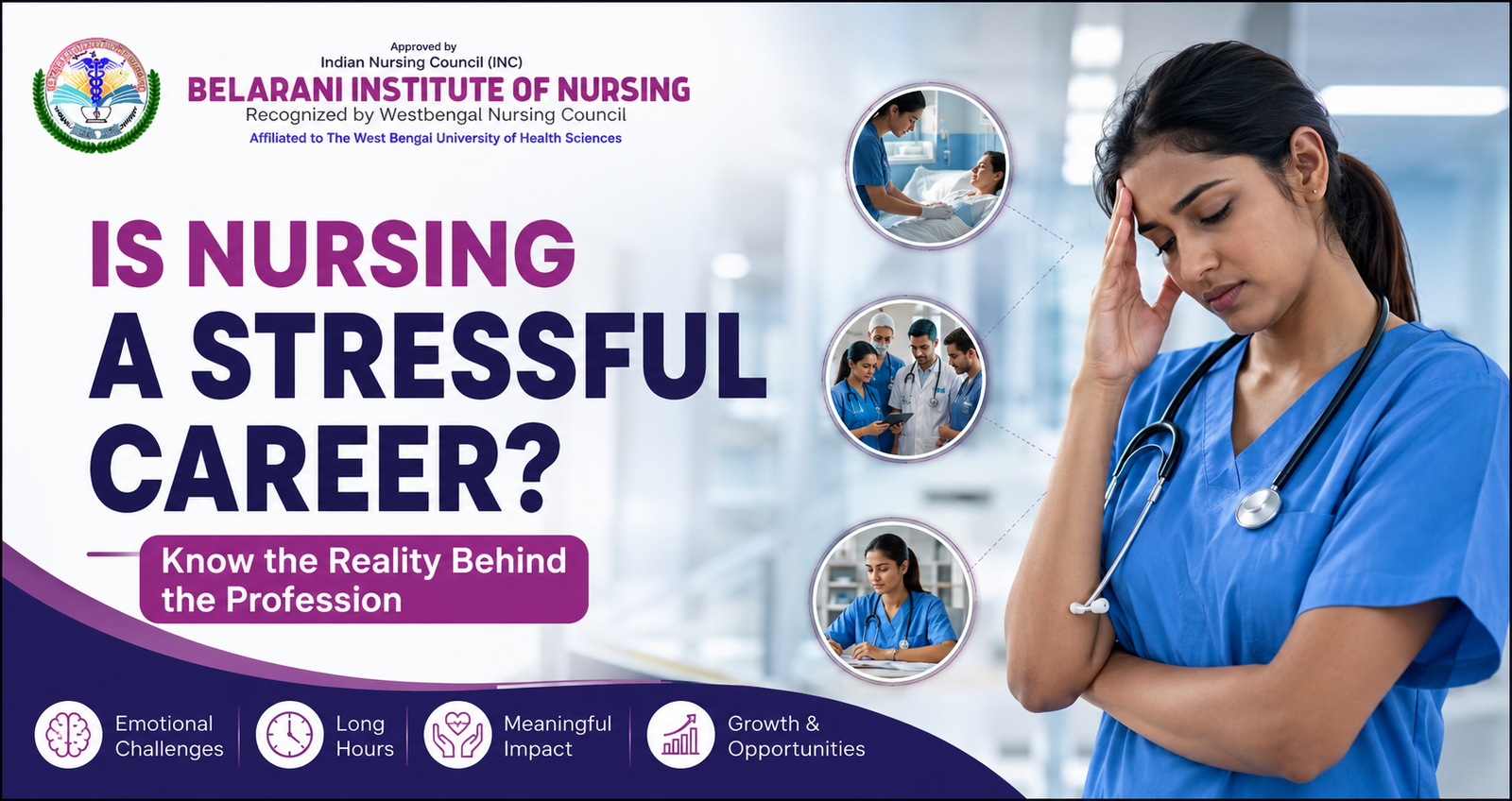
Is Nursing a Stressful Career?
We won’t dress this up. It consistently appears in surveys of the most demanding professions and the reasons are specific.
Long shifts. Twelve hours is standard in most hospital settings. Physical demands high enough that injury rates in nursing are comparable to some manual occupations. Emotional labour, managing your own feelings while actively supporting a patient’s grief or a family’s fear, is constant work that most programs don’t teach as a formal skill. Staff shortages in Indian healthcare mean nurses regularly cover more patients than guidelines recommend. Administrative load keeps growing.
And still, nursing has one of the highest career satisfaction rates in healthcare. We see this in our own graduates. The job is hard and genuinely meaningful at the same time. These are not contradictions. They’re both the truth.
What Nursing Actually Gives You?
Job security that very few careers match. We’re producing nurses at a time when India, and frankly most of the world, has a shortage of trained healthcare professionals. That gap is getting larger, not smaller.
Real human impact. The difference our graduates make to patients during illness, surgery, recovery, or end of life is direct and visible.
Multiple directions. Clinical nursing, community health, teaching, specialisation, administration. Our graduates don’t get locked into one track.
International options. Indian nurses are actively recruited in the UK, Canada, the Middle East, and Australia. A qualification from us opens doors outside India.
A respected profession. Nursing sits at the top of trusted professions in public surveys year after year. That means something in how you move through daily life and work.
The Most Stressful Nursing Jobs
Some specialisations carry more acute pressure than others and we think students should know this before choosing.
Emergency nursing: It is what most people picture when they think intense. Unpredictable volumes, life-threatening situations arriving without warning, decisions made fast. The pace is relentless in a way most other departments aren’t.
ICU and critical care: It is different stress. Severe cases, high stakes, deep connections with patients who don’t all survive. The emotional toll in these departments is real and documented.
Oncology nursing: It means being present with patients through some of the hardest experiences of their lives. Losses are frequent. The weight accumulates.
Psychiatric nursing: It involves behavioural emergencies and ethical complexity most other nursing roles don’t encounter in the same way.
We share this not to put students off these specialisations but because students who choose them knowingly do better than students who find out on the job.
What We Teach Our Students to Do?
Match your temperament to your specialisation. Someone who needs structure will struggle in emergency nursing even if they love the idea of it. Someone who wants depth of relationship may find ICU more rewarding than a busy general ward. We help students think this through before they commit.
Build coping skills early. Emotional decompression after difficult shifts, peer support, knowing how to genuinely leave work at the end of a day. These are professional skills, not personality traits. We build them into the curriculum rather than leaving students to figure it out alone.
Find mentorship in the first year. The jump from student to registered nurse is the hardest transition in a nursing career. We stay connected with our graduates through that first year because we’ve seen the difference it makes.
Hold the boundary between work and personal life. Every nurse knows they should. Most don’t manage it in the early years because the job pulls hard. We talk about this repeatedly because it’s what makes the career sustainable rather than something that burns out in five years.
Know when the problem is the environment. Short-staffed ward, difficult manager, toxic team. Structural problems, not personal failures. Recognising this matters and we prepare our students for it.
Things Worth Doing
Watch for burnout signs early. Poor sleep, emotional detachment, dreading shifts. Address them in weeks, not months.
Stay connected to peers outside work. The nurses who last longest almost always have strong colleague networks.
Keep developing. Further qualifications, new specialisations. Nurses who grow in the profession report higher satisfaction than those who stay static.
FAQs:
Is nursing really that stressful?
Yes, and we tell them so. Manageable with the right preparation, the right environment, and the right people around you.
Is it worth it?
Our graduates who’ve been working for five or more years say yes. The work carries meaning that’s hard to find elsewhere.
Which nursing jobs are hardest?
Emergency, ICU, oncology, and psychiatric nursing. High pressure, high reward.
The Nurses Who Stay
They’re not the ones who found it easy. They’re the ones who went in knowing what to expect, chose environments that suited them, and had the preparation to handle what the job actually asks.
At Belarani Nursing, we prepare students for both sides of this profession. The clinical content and the reality of working in it. Because that’s what it takes to not just qualify but to actually build a career in nursing.
Read More:
- ANM vs GNM vs B.Sc Nursing: Which Course is Best?
- How Nursing Courses Help Build a Rewarding Healthcare Career
- Benefits of Nursing Courses ?
Visit Us: